Sustainable fashion: has thrifting for vintage finds become problematic?
Posted Dec 4, 2022 1:07 pm.
Last Updated Dec 4, 2022 2:43 pm.
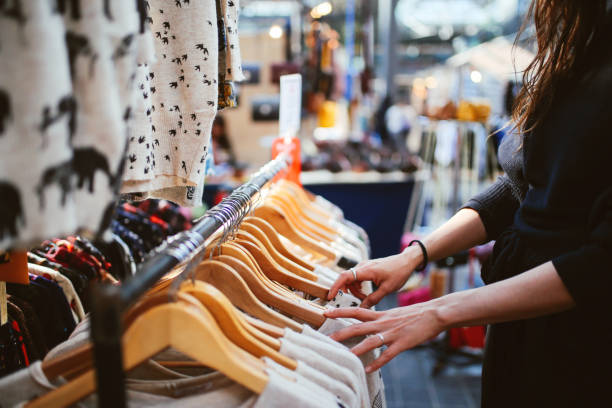
Is the sudden popularity of thrifting for garments still a sustainable option, especially in terms of affordability?
With the cost of living skyrocketing due to inflation, many are looking to become more budget savvy, especially for their clothes, including how frequently they shop and what types of designer labels they opt to add to their wardrobe.
Some thrift stores are no longer affordable outlets for families, as people are buying items to resell them for double or even triple the price. It’s a recent phenomenon known as the gentrification of clothing.
“It’s funny because I think thrift store owners are very much split on the idea of resellers coming in and buying things, and then selling them online or whatever for their own personal profit,” said Gillian Scupa, owner and operator of Calgary’s Thrift Couture.
“If someone wanted to come in and buy $1,000 worth of stuff, I really don’t care what they’re going to do with it. If they can resell it, great, but if I’ve already gotten my money out of it, I don’t have a problem with resellers.
“But I do know many who do. And I know of thrift stores that will put a limit on resellers (who) can only buy two items.”
From Scupa’s perspective, it’s a free market so if someone buys something and someone else is willing to pay more for it, it only seems fair.
“I think there are two worlds. Online shopping, so these retailers that buy the higher-end stuff and sell it online. And then the other is just the actual thrifting. I find true thrifters need to touch things and see them in person and kind of walk around. Because it’s their story. It’s not like you’ve got 15 copies of the same shirt in all different sizes. Everything, every single piece is different from the next,” said Scupa.
“So I think that as far as thrifting goes, the brick and mortar, (there) will always be a place for it.”
Read More: How your donated clothes end up burning in landfills a world away
She also says many people these days participate in thrifting not because they are thrill seekers trying to uncover a vintage find or because they hope to profit by reselling the garments, but due to altruism and a genuine effort towards reducing environmental impact.
“I believe I’m seeing that the younger generations are really kind of putting their money where their mouth is with all of the climate stuff going on in today’s world, that is the younger generations are much more aware of it and conscious of it,” said Scupa.
“It’s significantly much better for the planet. They say a pair of jeans costs something like 6,000 litres of water to make one pair,” said Scupa.
Scupa adds with the recent affordability crisis, thrifting is not about to go out of style anytime soon.
And many people just can’t justify spending money on brand-new clothing consistently.
“It’s definitely the majority of it that people have fewer dollars in their pocket. But they’re used to shopping at a certain level of once a year, every second week, and they want to keep being able to do that because it does feel good.”
Scupa say one way Calgarians can support the practice of thrifting is by buying local.
“I think that there’s a real distinction between thrift stores, like mine that are privately owned. And then, the big box thrift stores: Value Village Goodwill, and Salvation Army.” said Scupa.
“It makes me a little sad that if someone is really into thrifting, if they’re only doing the big box stores, they’re not getting to see these kinds of local neighbourhood hidden gems that really provide so much more personality to the event. Thrifting should be fun.”
Read More: Calgary’s Women in Need Society takes aim at food insecurity
Still, there are others that are open to combating the exploitation of fast fashion and arbitrage using social sharing services.
For instance, by starting up social sharing projects in the community through local clothing swaps in Calgary with the mantra of neighbours helping neighbours.
For example, the “Buy Nothing Project” is an online initiative to offer people a way to give, receive, share, lend and express gratitude through a worldwide network of hyperlocal gift economies.
Basically it’s a free and local goods-sharing service that allows someone to donate or swap their gently used items with their neighbours.
Adrianna Bauman created a Facebook group for the neighborhood of Banff Trail in June 2018 and it immediately took off. The group has 690 members.
“So it is a platform that’s based on Facebook and it connects people who decide to join from the neighbourhoods that are included in there, so there’s no selling at all,” said Bauman, the Buy Nothing of Banff Trail, Capitol Hill, and Hounsfield Briar Hill group founder.
“But you can either gift things away to your neighbours or you can ask for things that you might need.”
For example, clothes, furniture, baby items, leftover food from parties and big events. And some people even donate and share their time if someone needs help with a task.
Read More: Calgary community fridge feeding people with take-what-you-need service
Bauman for example lives in the neighbourhood of Banff Trail. And it was created intentionally with walking distance in mind so nobody would have to take transit to pick items up.
“Our community is an older community and has a little bit of an identity problem. I started this to just get people to connect to one another because we have a lot of short and long-term residents that are here because we are right beside the university. And I wanted a way for people to meet someone other than just the neighbours on the block,” said Bauman.
As an environmental scientist, Bowman says a big part of her interest was not just the walkability factor but the reusing of hard goods and textiles.
“I see a lot of value in diverting waste and the community-building aspect of it is great,” said Bauman
“And who can resist free things when they’re nice and also getting rid of them and not having to do that?” added Bauman.
Bauman mentions that it kicked off and resonated with a lot of people as they immediately saw the value of meeting and greeting their neighbours as opposed to donating and shopping from Good Will or Value Village.
Read More: New ‘take what you want, pay what you want’ donation market prepares for grand opening in Calgary
She says with the inflated cost of living these days they are seeing new members being keen to join in and participate.
“So we go through fits and spurts of having new members join and recently there’s been a lot more buy-in. And I can’t say if it’s necessarily people feeling the pinch but also because we’re starting to make more headways in neighbourhoods and building a lot more community and getting involvement that way,” said Bauman.
“It seems like there is a bit of a momentum in this area now to connect people and also have more buy-in and investment from folks to participate in activities around here.”
Bauman adds that sometimes the group has also become a catalyst for others to be connected to each other and for individuals to build friendly relationships with one another.
For example, some members are getting together to participate in clothing swaps, community days or games nights.
–With files from Tiffany Goodwein