Calgary ER doctors treating more unhoused frostbite patients in extreme cold
Posted Dec 23, 2025 12:25 pm.
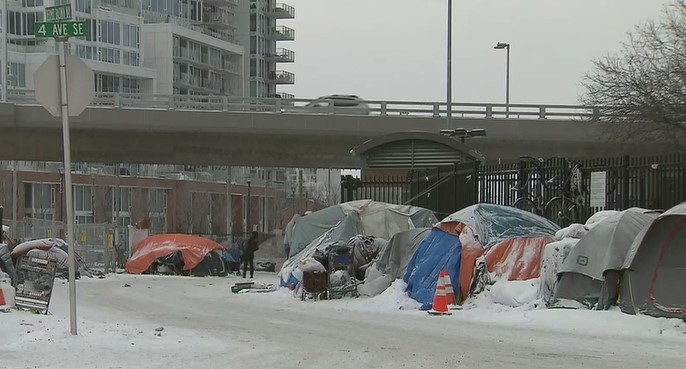
As deep freeze temperatures linger across the province, Calgary ER doctors are treating more and more frostbite patients — most of them unhoused.
It happens when the skin is exposed to temperatures below 0 C for an extended period. Alberta Health Services says the affected skin may look white and waxy and will “feel hard to the touch.”
Environment and Climate Change Canada says the extreme cold across the Prairies poses a severe risk of frostbite or hypothermia, which can develop within minutes on exposed skin, especially with wind chill.
Dr. Catherine Patocka at the University of Calgary’s Cumming School of Medicine says it’s something she sees every winter, and it’s our city’s most vulnerable who are being impacted most.
“Certainly, our substance use crisis in this province — in this country — is contributory because when you use substances often, you are altered and you can’t appreciate the environment around you and not appreciate that your digits are freezing until you’ve already, unfortunately, suffered the frostbite.”
This also comes as the Edmonton Zone is reporting an increase in frostbite amputations, mostly affecting its homeless population. Calgary broke a 10-year high in frostbite amputations in 2023.
And while Calgary doctors are also seeing more patients with frostbite, Patocka says it’s unclear whether those patients will lose an extremity.
“The priorities are to rewarm those digits, and then there’s kind of an escalating protocol of treatments that we can offer, but we never know at the end of our visit whether somebody will preserve their digits or not,” she said.
“That comes many months later.”
Watch: Frostbite amputations remain high in Edmonton as shelters expand beyond capacity
With Patocka saying it’s unhoused Calgarians who are most at risk, Sandra Clarkson with the Calgary Drop-In Centre sees it firsthand.
“Our goal is to do whatever we can to encourage people to come in to access services so that they’re not experiencing frostbite and that they know that there are actual options out there,” she said.
Calgary shelters are also being stretched to the limit right now, and BeTheChangeYYC is looking for a new home due to the City of Calgary closing the building where its headquarters is located.
Clarkson, however, says there is a coordinated effort to find more space for those in need.
“The Mustard Seed, Salvation Army, Alpha House, Calgary Drop-In Centre, and In From the Cold. We speak on the regular to make sure we know where there’s space, and we’ll do whatever we can to make sure that people are welcomed,” she explained.
Between extended day spaces, outreach and warming centres — city partners are responding.
The Calgary Homeless Foundation, the City of Calgary, and over 20 partner organizations started the annual extreme weather response, which provides seasonal day spaces, overnight transportation to emergency shelters, and critical winter supplies. It runs from Dec. 1 to March 31.
However, Clarkson says that’s just one part.
“Homelessness happens each and every day of the year. It’s not weather dependent, and I think we really need to stay focused on what the solution to ending homelessness is, and that is deeply affordable housing and housing with appropriate support,” she said.
Chris Gallaway with Friends of Medicare echoes that sentiment, saying housing is healthcare, and an urgent plan to tackle the housing crisis to get people sheltered from the cold is needed.
According to the Calgary Homeless Foundation’s Point-in-Time Count from October 2024, 3,121 Calgarians are experiencing homelessness.
The ECCC says the weather in Calgary is expected to hit 7 C on Sunday.