National Geographic Live presents: Cave of Bones, a look at humanity through another species
Posted May 26, 2026 5:30 pm.
Last Updated May 27, 2026 10:11 am.
What makes humans different than the other animals on this planet?
That is the question at the centre of National Geographic Live Presents: Cave of Bones, where one of the world’s leading paleoanthropologists will unpack discoveries that have shifted our understanding of humanity.
Lee Berger, a National Geographic Explorer in residence, is bringing Cave of Bones to the Jack Singer Concert Hall as part of the National Geographic Live series on May 31 and June 1.
His work focuses on some of the most significant finds in human origins in recent decades- discovering a new species of homo, not directly related to homo sapiens as we are known today.
“I’m going to be talking about some of the most significant discoveries in human origins,” Berger says. “The story of where we came from that has been made over the last two decades that are quite literally transforming the way we understand not only how we got to this place… but also new ideas around how the fossils we are discovering, the cultural evidence we are discovering are showing us that we’re not the only exceptional animal that has ever lived.”
At the centre of that work is the discovery of homo naledi, a species first uncovered in South Africa in 2013.
The grave site he has excavated suggests homo naledi was deliberately disposing of its dead in ancient cave systems about 250 thousand years ago; those same behaviours were not seen in modern humans until about 150 thousand years ago.
Not only that, but Berger says the grave site holds evidence of symbols and tools being purposely carved. While he hesitates to label it as art, he does believe it shows culture.
Berger says the species challenges assumptions that have shaped the field for generations.
“When we first announced homo naledi, we said that this… was a cultural species with a brain the size of a chimpanzee and that it was deliberately disposing of its dead in these remote caves,” Berger says.
The response from the scientific community was immediate.
“That went over like the proverbial lead balloon,” he says. “Largely because they weren’t ready for it. We weren’t ready for it as a field.”
For decades, the dominant theory tied human behaviour to brain size.
“Our whole narrative had been built around the reason that humans behave the way they do is because of this… this gigantic, big brain,” Berger says. “If it were true that naledi was a complex cultural species at our level, then that narrative wasn’t true.”
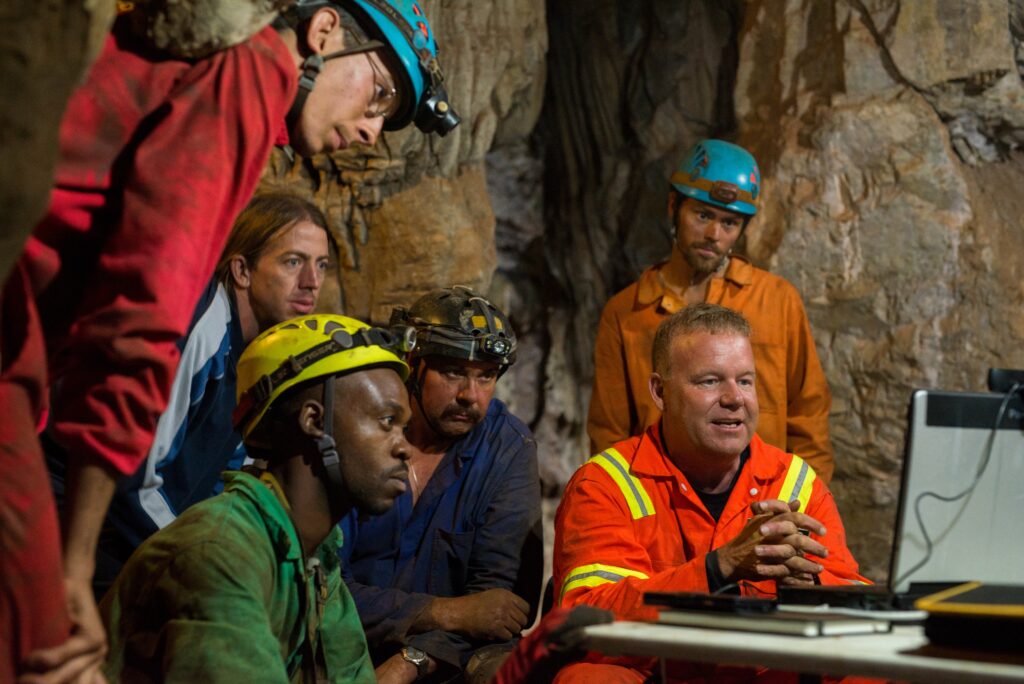
Researchers had to navigate narrow cave systems deep underground to reach the fossil site; only people of a certain size could access the area.
“I used a group of extraordinary women scientists that became known as the underground astronauts to crawl into some of the most extreme places archaeologists have ever worked in history,” Berger says. “Spaces around 17.5 centimetres… dozens and dozens of meters underground in incredibly dangerous environments.”
Berger says that subterranean cave systems and deep oceans remain among the least explored areas on the planet.
Berger says the presentation at the Werklund Centre draws from thousands of fossils and cultural remains, but also from the experience of discovery itself, what it is like to enter spaces where very few people have ever set foot.
“I’ll give the audience a real feel of what it’s like for those of us who are privileged enough to get into these spaces,” he says. “Which are otherworldly.”
Tickets are available here.