Calgary marks one year since catastrophic feeder main break
Posted Jun 5, 2025 7:06 am.
Last Updated Jun 5, 2025 7:35 pm.
Thursday marks one year since the pipe carrying 60 per cent of Calgary’s water supply burst in the northwest, prompting months of restricted water use and several investigations.
It all started on the evening of June 5, 2024, when water began flowing onto 16th Avenue NW in Montgomery, drenching the Trans Canada Highway and neighbouring areas like Shouldice Park.
Mayor Jyoti Gondek spoke at city hall on Thursday, reflecting on the rupture that plunged the city unto a water crisis.
“The situation was dire,” said Gondek, “A major pipe delivering water to hundreds of thousands of residents had failed, and the impact was immediate.”
Calgary later declared a state of local emergency.
Many residents in communities near the pipe rupture were left without water and Bowness was placed under a boil water advisory.
“It felt like COVID all over again, we had no business,” says Cheryl Anderson, owner of Pin Ups Hair Shoppe in Bowness. “We lost so much business people just assumed we were closed.”
She says reduced foot traffic meant a 70 per cent drop in business last summer.
WATCH: Memories of Calgary’s water feeder main break
All Calgarians were eventually advised to take shorter showers, only do laundry and dishes when necessary, flush toilets periodically, and refrain from watering their lawns.
Water restrictions persisted for weeks after the initial incident, making the summer of 2024 one to remember for all the wrong reasons.
What followed was a series of press conference, stark warnings, and several internal and third-party investigative reports.
One of which, released last week, reported the pipe failure was not the fault of the city or its engineers, but rather lax regulations around pipe composition and installation in the 60s and 70s.
City reflects on progress one year out
The city says they have made 29 repairs since last June that have strengthened Calgary’s water system for the future.
“Looking back at the past year I’m impressed by how much work we progressed with the support of Calgarians who played an integral role in keeping demand low while we executed essential repairs,” says Michael Thompson, General Manager of Infrastructure Services.
“We continue to be committed to building a stronger water system that will meet the needs of Calgary and the surrounding areas for generations to come.”
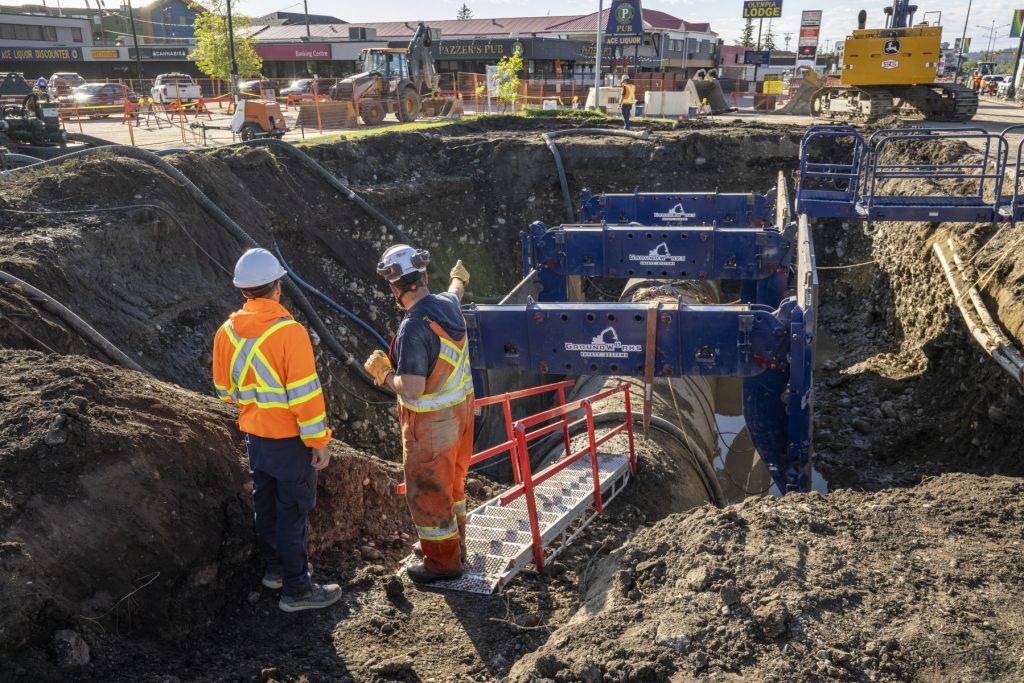
The city says actions taken over the last year include emergency repair on feeder main break and repairs on five urgent hotspots in the same month.
Crews also made 21 urgent repairs in September followed by two more in November. Since then, the pipe has been closely monitored using fibre optic technology.
“To the city teams and the contractors who worked around the clock, often under dangerous situations, there are two folks who even sustained injuries on this repair, you kept the city running when it mattered the most,” Gondek said Thursday. “I can never thank you enough
“The work you did is something that we must always remember.”
City staff have also developed an “enhanced emergency response plan” and expanded parts inventory to better support future emergency repairs.
Couns. Sonya Sharp and Terry Wong marked the anniversary with an election campaign stop at the site where the pipe burst, calling for more focus on protecting the city’s infrastructure.
“We keep dumping density into neighbourhoods like these without a full understanding of whether or not our infrastructure can handle it,” says Sharp. “That’s just wrong and needs to change.”
Five retired oil and gas professionals have been chosen to make up a panel examining the feeder main crisis.