Alberta premier defends funding threats after letter demands judicial reform

Posted Feb 7, 2026 3:16 pm.
Last Updated Feb 8, 2026 10:29 am.
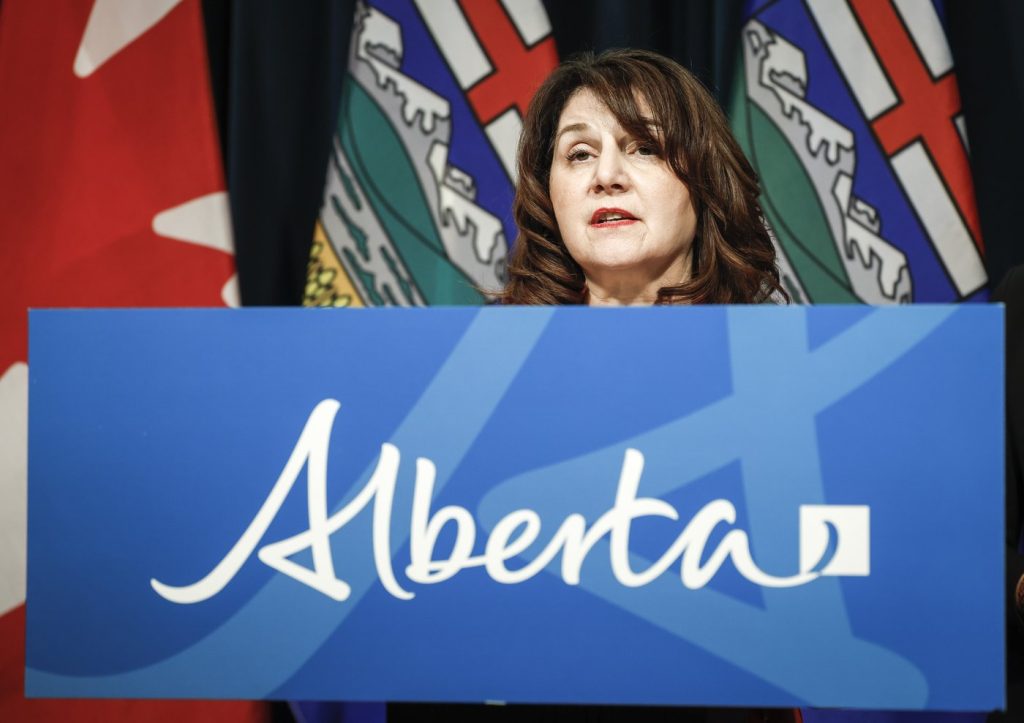
Alberta Premier Danielle Smith is defending her threat to withhold funding from the judiciary if her government doesn’t have more say on their appointment on Saturday, calling it a negotiating tactic.
Smith said during the bi-weekly radio show Your Province, Your Premier that she would rather get a fair conclusion and parity in the appointment process.
“I’d rather get to a conclusion that is amenable to both of us and fair to both our provinces as well as acknowledging that there’s a federal role to play, of course. But I think we want some parity,” she said.
“So, we’ve started the conversation, and hopefully we’ll have some success on it.”
Smith also says the call for judicial reform came from Minister of Justice Mickey Amery, saying “he is the one making the ask.”
“I trust his judgment.”
Her comments come after she penned a letter to Prime Minister Mark Carney on Jan. 23 — made public Tuesday — saying she expects “meaningful engagement” after asking him to let her province have more say on how judges are selected, threatening to withhold court funding if Ottawa didn’t agree to her proposed process.
The letter proposes a special advisory committee with four “non-partisan experts” — two appointed by the province — to assess candidates on a “non-partisan basis” while ensuring candidates have the expertise to serve in roles on the Alberta Court of King’s Bench, the Alberta Court of Appeal, and the Supreme Court of Canada.
She also said it would ensure judicial appointments “appropriately reflect Alberta’s distinct legal traditions,” and strengthen public confidence in the administration of justice.
Federal Justice Minister Sean Fraser said he won’t act on her call, saying the process is already independent and is “working very well.”
The Canadian Bar Association, which represents 40,000 lawyers, judges and legal professionals across the country, also said it’s concerned that Smith’s suggestion that courts don’t reflect the “values and expectations” of Albertans underscores the political nature of her proposal.
Host Wayne Nelson confronted her with statements from various people, both agreeing and disagreeing with the proposal. He says those who disagree say the premier is going about it the wrong way, that using political influence in this way could undermine public trust, and lastly, compares her to Trump.
Smith didn’t address the Trump comparisons, but remarked, “Quebec does it,” and that her government is trying to get the “same level of respect” afforded to Quebec.
“One of the things that they do in Quebec is they have a joint committee with an equal number of members at the provincial level and the federal level, and they come to a consensus on the judges to a point,” she said.
According to the application process for the Alberta Court of Justice, the judicial review council consists of the chief justice of Alberta, the chief justice of the Court of King’s Bench, the chief justice of the Court of Justice, the president of the Law Society of Alberta, and two people appointed by the minister of justice. The minister of justice then appoints judges to the court of justice and a justice of the peace, as do all provinces and territories for their respective courts.
Provincial superior courts are appointed by a federal seven-person committee, which applies to Alberta and Quebec. However, the latter has west and east regional committees, according to the Office of the Commissioner for Federal Judicial Affairs Canada.
Three appointees representing the public come from the federal government, and another from the province’s chief justice. The remaining choices come from specific provincial institutions, including one from the Ministry of Justice.
Heather Jenkins, the press secretary for the Minister of Justice, said in a statement that the judicial appointment process should be “truly collaborative,” while insisting there’s a compatible framework with the federal superior court committee — which applies to every province — and the Supreme Court of Canada appointment committee for Quebec judges.
“The current Federal Judicial Advisory Committee for Alberta only includes one Government of Alberta nominee, but three nominees from the federal government. In Quebec, a specific board is formed that includes two members appointed by the federal government and two appointed by Quebec. That is why Alberta’s government wants to work together with the federal government to identify candidates through the establishment of a Special Advisory Committee with equal membership from the Alberta and federal governments,” her statement reads.
By law, three of nine seats on the Supreme Court are to be appointed from Quebec. The remaining seats, by tradition, are to be filled by three judges from Ontario, two from the western provinces or Northern Canada, and one from the Atlantic provinces.
Smith, meanwhile, also lays the blame on former Prime Minister Justin Trudeau’s government for the need for reform, saying “catch-and-release” federal laws changed multiple times, “upturning our sentencing guidelines.” Smith also says the bilingual requirements are unfair and “stack the deck” against Alberta.
“We’re now in our third bill at the federal level to try to give new guidance to the judges so that they don’t do catch-and-release and get bad guys back out into the community,” she said.
“So we do have a role to listen to people and to — through the criminal code — proper channels, make sure that we’re making those changes.”
Alberta’s French lawyers association and the provincial chapter of the French Canadian Association have pushed back, saying the existing requirement protects and ensures access to justice.
Recommendations from the Alberta Next Panel, based on input gathered via surveys and town halls throughout the province in 2025, and Smith’s letter refer to Canada as an outlier on judicial appointments, noting Australia is an example of a judicial system that allows the state to choose its superior court judges.
The Australian Judicial Officers Association says federal-level judges are appointed by the governor-general from a selection by Australia’s federal cabinet with advice from the attorney-general, and state and territory judges are appointed by the governor, also from a selection by the federal cabinet with advice from the attorney-general.
With files from The Canadian Press