Chief concerns: Calgary’s top cop talks tackling the city’s issues

Posted Sep 22, 2025 5:01 pm.
Last Updated Oct 3, 2025 7:18 am.
It was recently announced that Calgary’s top cop would be sticking around a little longer.
CityNews recently sat down with interim chief Katie McLellan to learn a bit more about how she got here and her vision for the city.
Family dinners like a Blue Bloods episode
Katie McLellan always wanted to be a police officer.
She didn’t know anyone working as one, but she created a family of like-minded loved ones who also put on the uniform. She married a police officer, and their two sons now work on the frontlines of the force, where she is now chief. Their daughter is in culinary school.
“It’s been a crazy ride,” McLellan says. “I always wanted to be a police officer.”

It began when the Father Lacombe High School grad took on a summer student position in the victims’ assistance unit. After that, she worked as a TAP (they were called telephone answering people back then) at the 911 centre.
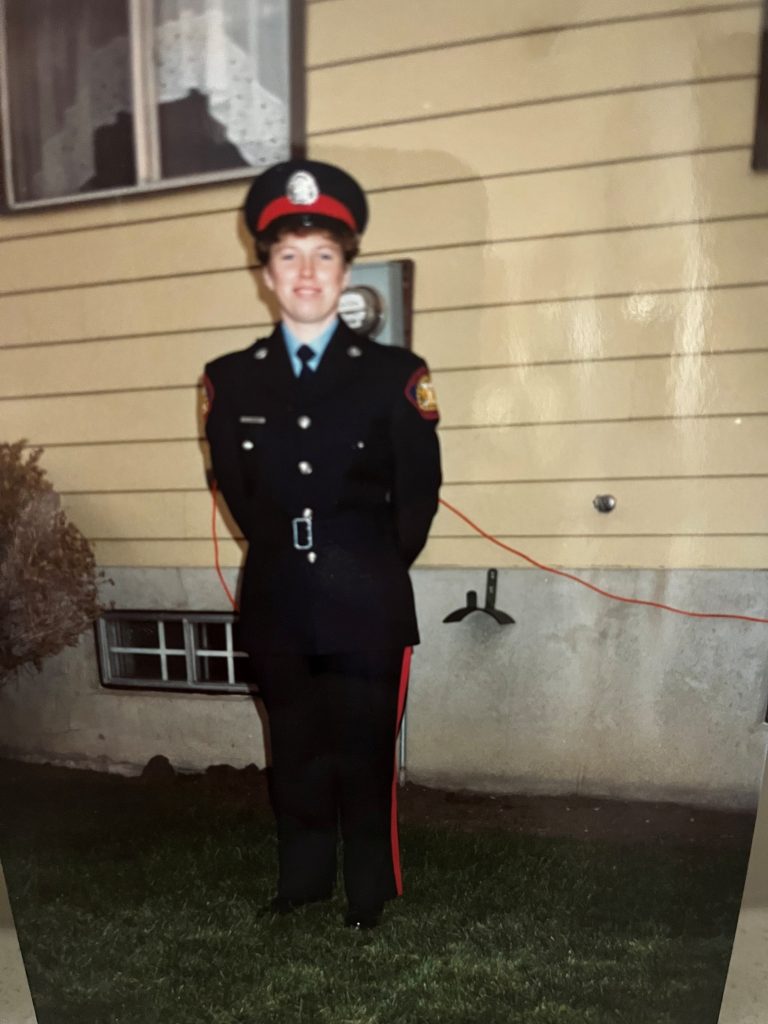
In 1987, McLellan was a Calgary Police Service officer on patrol in the Forest Lawn, Dover, and Penbrooke Meadows areas.
In 2013, the 45-year-old retired with a robust resume.
She worked corporate security consulting for a stretch, but with policing “in my blood,” she was soon back where she belonged, working with the RCMP before returning to her Calgary police roots as a deputy chief.
In May, Chief Mark Neufeld resigned, and McLellan was asked if she would be up for the job.
“It’s still surreal,” she says. “I’m living the dream.”
“Every morning I look in the mirror and go, ‘Is this really happening?’ Even after all this time, now 35 years in policing, I still have so much pride belonging to the police, particularly the Calgary Police Service. Every day, I’m so proud of what our members do to keep this community safe.”
From homicides to traffic stops — what exactly do police do?
During that detour to the private sector several years back, McLellan says some people were curious about what keeps police busy.
“They would ask, so what do you guys do? Homicides and traffic stops?” she recalls. “Well, there’s a tad bit more than that.”

From staffing the frontlines to ramping up traffic safety efforts to steering youth clear of crime and supporting investigative units, she says police work is increasingly complex.
“What should a police officer be? Should they be involved in schools, prevention and intervention, and education? Well, of course they should be,” McLellan says.
But it’s challenging to do it all.
Bolstering the police budget
As definitions and expectations of what roles police play in the community continue to expand, so does the cost.
When resources are allocated to the inner city to address issues, for instance, surrounding communities often ask, “Where are the cops?”
Statistics Canada numbers show Calgary among the lowest when it comes to the so-called cop-to-pop ratio. The average for 11 major cities selected sees 582 citizens per police officer. In Calgary, that number is 650.
While the budget for 2023-2026 is $600 million, McLellan says they will make the case for more when the 2027-2030 budget goes to council for approval next November.
“We will be asking for a large increase,” she says. “It’s not just about hiring a police officer and not as simple as putting a police officer in a car, and you are good to go.
“Some of those calls take way longer than they used to. Back in the day, when I was a young whipper snipper, we could investigate an impaired in about an hour and a half, and now it’s seven or eight hours. There are all these additional complexities.”
It’s also not just taking calls for service but about building community relationships, proactive policing, and growing the service in a city that continues to expand by about 10,000 additional people each month.
“What is it that Calgarians want from a police service? If they want a top-notch sex crimes unit, child abuse unit, homicide unit, and then you want enough police officers … you need more people,” she says.
Calgary Police Commission chair, Amtul Siddiqui, says over the next 12 months, the plan is to work with CPS to ramp up recruitment and reduce the number of officers on leave by improving back-to-work support.
“The Calgary Police Commission wholeheartedly agrees that Calgary needs more officers. You will see this clearly reflected in our upcoming proposal for the next four-year budget cycle, which includes our request for a significant increase in officers,” Siddiqui says.
Good, better, best — no time to rest
Although McLellan says Calgary is a relatively safe city, there is still work to be done. Supporting community wellness and tackling social disorder are top areas she wants her team to target.
“We are a safe city when you compare us to other cities across the country. But those are just statistics,” she says. “It is our job every day to make it safer.”
McLellan is troubled to see so many youth involved in crime here and across the country.

“A couple of months ago, three kids were stabbing a transit officer. They were all under the age of 18. Over the past month and a bit, I can tell you there have been several youths picked up in stolen vehicles and for assaulting people. Anecdotally, I can tell you on a daily basis, there are interventions and incidents that happen with young kids,” she says. “It’s sad.”
“Our kids are our number one assets. So the more we can instill good ethical, strong moral behaviors and teach them about the right side of the law, the better,” she adds. “We should be part of that because we are part of this community, too.”
Lives lost on city streets are also high on the agenda for police and partners to address. More than two dozen people have thus far lost their lives in collisions. Many were driving too fast. About half were pedestrians and motorcyclists.
“And a lot are young people,” she says. “It’s just absolutely heartbreaking to hear the number of people injured and killed, and there is no need. Speed kills. People have to slow down.”

As part of the ongoing efforts to promote road safety, the province ordered the removal of traffic enforcement cameras on provincial highways late last year. In a similar vein, Calgary police, with the support of the community, have been given the go-ahead to install cameras for red light and speed enforcement at two problematic intersections.
“It’s funny. Most often, when we do surveys, one of the top five or six issues that come up from the public is traffic safety. But when we bring in red light cameras and speed on green, people are like, ‘I don’t want traffic safety,’” McLellan says.
And as much as police serve Calgarians, McLellan stresses they don’t work in a silo but in partnership with the community.
“There is always someone who knows something,” she says. “If you see something, say something.”