Wildfire risk rising globally, even in the Arctic: UN report
Posted Feb 23, 2022 6:26 am.
The threat of wildfires is on the rise globally according to a United Nations report which found that even the Arctic is seeing a rising risk.
Experts predict the number of wildfires will increase by 50 per cent globally by the end of the century, and governments are ill-prepared.
Released ahead of the United Nations Environment Assembly in Nairobi, “Spreading like Wildfire: The Rising Threat of Extraordinary Landscape Fires,” predicts the Arctic, previously all but immune, now faces rising wildfire risk.
It also suggests fires and climate change are fueling each other, calling them “mutually exacerbating.”
“Almost every vegetation region of the world has a free-burning fire at some time of the year. This figure shows the annual concentration of all vegetation fires (landscape fires and wildfires) observed per square kilometre (km2) for the period 2000–2020,” according to the report.
It adds governments around the world must radically shift their wildfire investments from reaction and response to prevention and preparedness.

“Almost every vegetation region of the world has a free-burning fire at some time of the year. This figure shows the annual concentration of all vegetation fires (landscape fires and wildfires) observed per square kilometre (km2) for the period 2000–2020,” according to the report.
“If we want to try to reduce the magnitude of the damage and loss from wildfires, we need to rebalance the types of expenditure … We need to have more effort in the earlier phases – the review, analysis and risk reduction – in order to try to pre-empt the efforts that are required to try to reduce the impact of wildfires,” said Andrew Sullivan, one of the report’s authors.
That’s something the B.C. government has been wrestling with as fire seasons have become more intense and destructive. The government announced in the provincial budget Tuesday the BC Wildfire Service is becoming a year-round operation at a cost of $243 million.
Related Video:
Another $210 million is being set aside for community preparedness and wildfire prevention, along with Indigenous-led emergency management priorities, which is something the UN report also recommends, pointing to case studies in Australia, South America, the U.S., and in Canada.
“Integrated wildfire management, considering social and environmental dimensions, along with traditional, Indigenous land management, is key to adapting to current and future changes in global wildfire risk,” said Sullivan, during a media briefing.
The UN report lauds Canadian efforts to cooperate with local knowledge keepers. “In Canada, a national team of wildfire management experts has developed the Blueprint for Wildland Fire Science in Canada. One of the six priority research themes of this blueprints recognizing Indigenous knowledge, which represents the first national recognition of the need to collaborate with Indigenous peoples for better wildfire management.”
Related Articles:
-
Addressing climate change and its effects in B.C. a big focus for 2022
-
B.C. Budget 2022: Where are your tax dollars going?
-
Temperatures to drop in Metro Vancouver, Fraser Valley, and Sea to Sky regions
An Indigenous-led review of the massive Elephant Hill wildfire in B.C. in 2017 found better collaboration with First Nations and use of Indigenous fire management knowledge would have improved the province’s response to battling the Elephant Hill Wildfire.
The fire burned 200,000 hectares throughout the Secwépemc Nation.
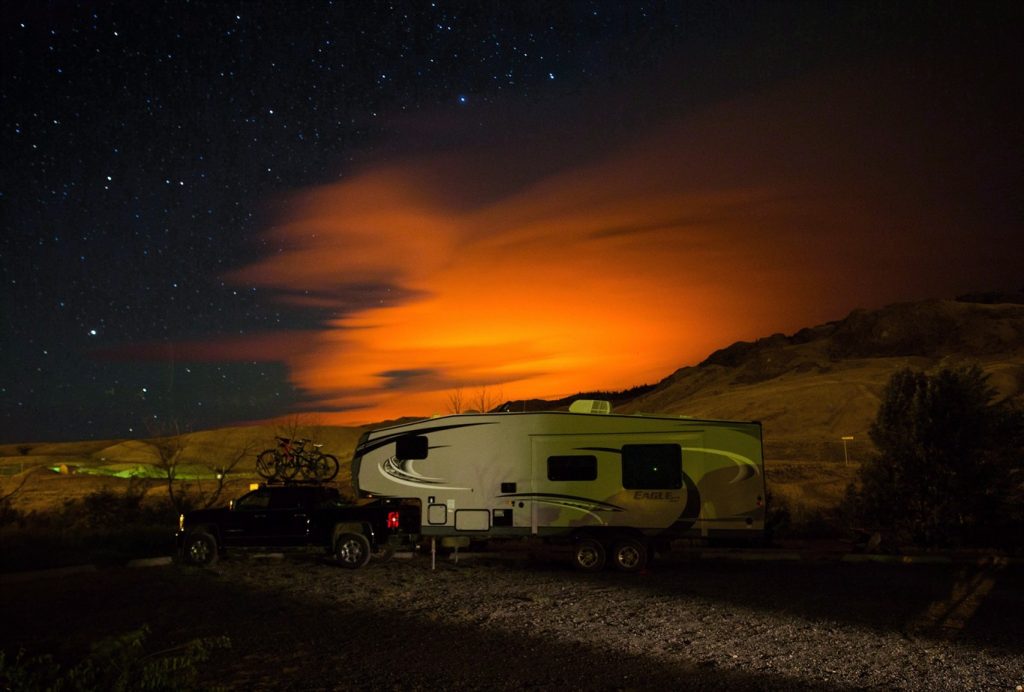
FILE — A trailer parked at a campground in Savona, B.C., is seen as the Elephant Hill wildfire burns in the distance near Clinton, illuminating smoke in the sky during the early morning hours of Sunday July 30, 2017. THE CANADIAN PRESS/Darryl Dyck
“In the immediate wake of this fire, and the significant and interconnected social, cultural, economic and ecological impacts that are still ongoing, affected Secwépemc First Nations advocated for Secwépemc leadership in the recovery and regeneration of their territories in the months, years and decades to come,” the report stated.