ATA says Charter override ‘endangers the rights of all Albertans,’ as Premier Smith pushes back against critics
Posted Nov 19, 2025 11:43 am.
Last Updated Nov 19, 2025 6:27 pm.
A dangerous escalation. Deeply concerning. Draconian.
That’s how the Alberta Teachers’ Association (ATA) is describing the province’s latest use of the notwithstanding clause – the second time in less than a month.
It’s now being used on legislation impacting transgender youth that was previously blocked by the courts, just weeks after it was invoked to end the weekslong teachers’ strike that forced 51,000 educators back to work and into a previously rejected contract.
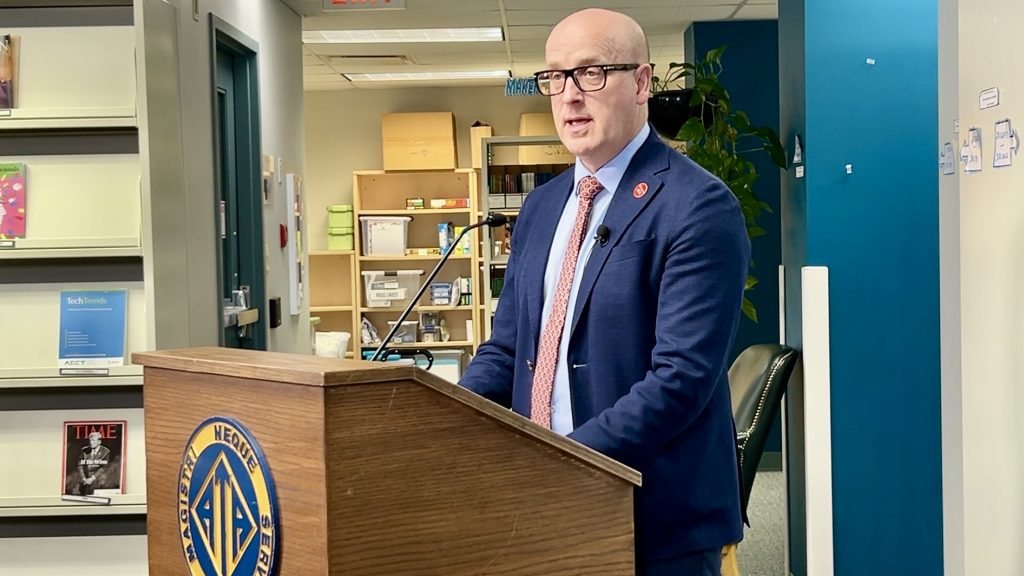
“The government is not simply asserting its policy preferences; it’s trying to ensure that no parent, no teacher, no student or no court can challenge these decisions, even when they affect fundamental rights,” ATA president Jason Schilling told reporters Wednesday. “This government is in effect saying that they know these new laws violate Albertans’ rights, and they want them to move ahead anyway.
“It is not routine governance. It is a dangerous escalation by a government that has grown far too comfortable reaching for the notwithstanding clause as a political weapon.
“When it begins to use it repeatedly across multiple sectors, it signals a deeper shift, one that endangers the rights and freedoms of all Albertans, not just those in education.”
The UCP government introduced Bill 9 on Tuesday to use the Charter’s notwithstanding clause to prevent legal challenges to three laws impacting transgender and gender-diverse youth and adults.
Premier Danielle Smith says the move is necessary to protect children’s health and well-being, which she added could be jeopardized if challenges to the laws are tied up in court for a long time.
The clause is being applied to three pieces of legislation, including:
- Bill 26, which prohibits gender reassignment surgery for youth and bans supplying puberty blockers and hormone therapy for the purpose of gender reassignment to anyone under 16;
- Bill 27, which mandates schools get consent from parents when a student younger than 16 wants to be referred to using a different name or pronouns, and introduces an opt-in system for school sexual education;
- Bill 29, which bans transgender girls from participating in amateur female sports.
“It forces teachers to report a child’s private conversation even if the child is not ready, even if the child is afraid, even if the child is simply asking a question about who they are becoming,” Schilling said. “Instead of creating safety, it can place vulnerable students at risk of rejection, punishment or emotional harm. It takes what should be a moment of trust and turns it into a mandatory disclosure.
“Schools should be safe spaces for every student to go, and when we put bills like this in place, we are undermining that safety for our most vulnerable kids.”
The clause overrides several sections of the Canadian Charter of Rights and Freedoms, the Alberta Bill of Rights, and the Alberta Human Rights Act.
“With this move, the government is attempting to place several sections of these acts beyond the reach of the Charter, beyond the Alberta Bill of Rights, and beyond the Human Rights Act,” Schilling said. “This is an extraordinary step, and it represents a pattern that teachers know all too well and should be deeply concerning for every Albertan.”
‘We believe in science’
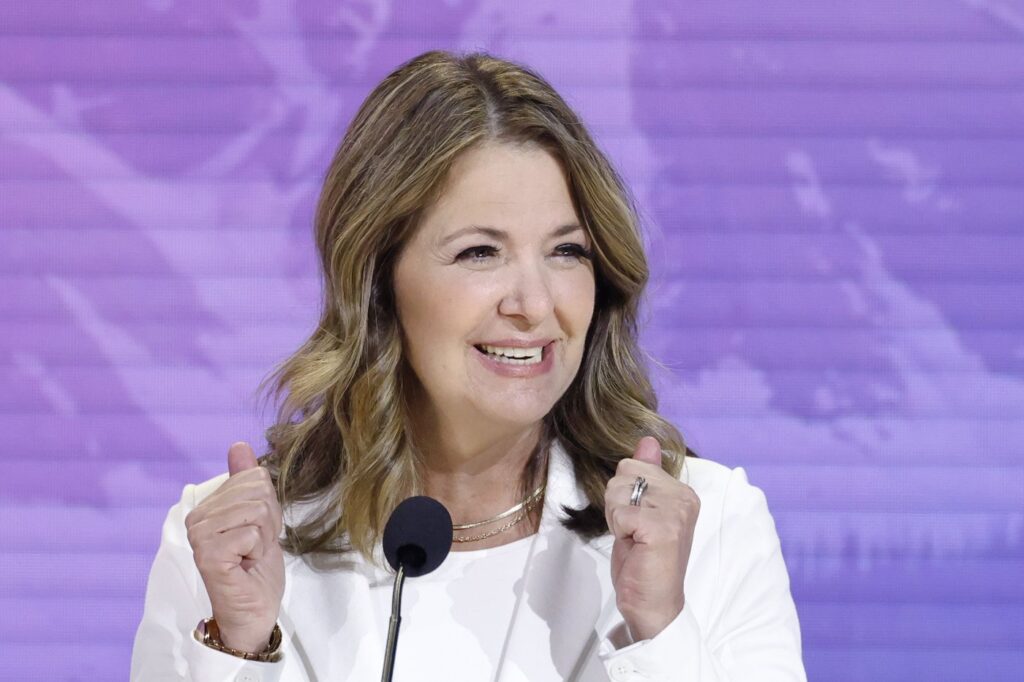
Alberta Premier Danielle Smith pushed back Wednesday on accusations that her government is trampling on Charter rights through repeated use of the notwithstanding clause, saying it’s all about protecting children.
In a heated back-and-forth, Opposition NDP house leader Christina Gray said the United Conservative government using the clause four times in the last three weeks is an affront to protected human rights.
“Does the premier understand that the repeated use of the notwithstanding clause literally means she opposes the freedoms of all Albertans,” Gray said.
“We believe in science,” Smith replied to guffaws from the house. “This is about protecting children and making sure that medical experiments are not conducted on them, because we do not have good data.”
LGBTQ+ advocacy groups and the Canadian Medical Association have challenged the law in court, calling it unconstitutional, a threat to the health of gender-diverse youth and an intolerable interference in the doctor-patient relationship.
Gray, citing the Canadian Civil Liberties Association, said Smith’s government has already targeted teachers and questioned who might be next.
“They know this is an abuse of power,” she said. “Why has the UCP decided to steal away parents’ freedoms to decide what is best for their own children?”
Smith hit back and argued the buck stops with elected officials, pointing to a recent ruling by the Supreme Court of Canada that one-year mandatory minimum jail sentences regarding child pornography are unconstitutional.
“We are not going to defer to unelected judges who do not have democratic accountability on their side,” she said.
Later in question period, Justice Minister Mickey Amery said hormone replacement therapies for minors have been restricted or ended in several European countries because of “detrimental impacts” on children.
“We are not outliers here,” he said. “We are at the forefront in Canada in protecting our children, and we are using the consensus of the global medical community to support our position.”
Ottawa weighs in
In Ottawa on Wednesday, federal Justice Minister Sean Fraser weighed in.
Asked what he thinks of Alberta’s use of the clause, he told reporters he’s concerned about it being used to address “very complex social issues.”
Fraser said the Constitution already allows for policies that run counter to people’s rights to be adopted — provided the policy can be reasonably justified.
“When you are reaching for the notwithstanding clause, what you’re essentially doing is saying we’re going to adopt a law without regard as to whether that law is reasonable in a free and democratic society,” he said.
–With files from The Canadian Press