Calgary officials continue to urge for reduced water use as demand trends higher
Posted Jan 3, 2026 3:06 pm.
Last Updated Jan 4, 2026 3:15 pm.
Officials are asking Calgarians to reduce their water intake before heading back to work and school on Monday, as the city is “trending toward the red” in water use on Saturday.
An update in the city’s water demand dashboard Sunday morning reveals 495 million litres of water were used on Saturday — two million more than on Friday. The city continues to be in a “strained” state after a portion of the Bearspaw South Feeder Main broke on Sarcee Trail and 16 Avenue NW on Dec. 30.
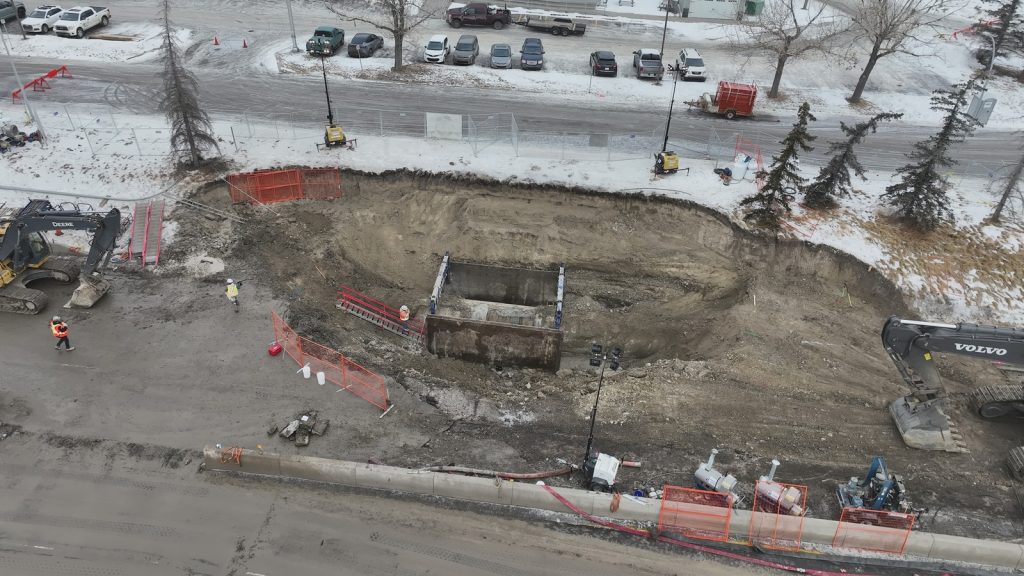
On Saturday, city officials said the water at the site has been drained, and the pipe has been excavated and uncovered. The pipe at the break location is being cut and prepped for removal accordingly. The next stage is to assess the condition and install a new pipe.
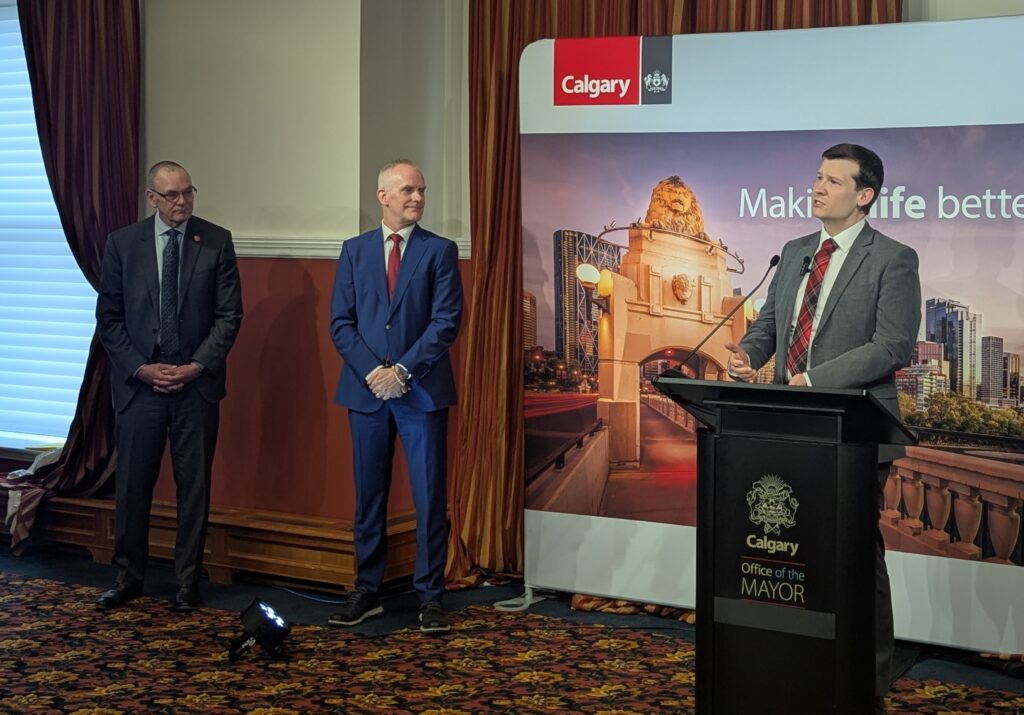
Calgary Emergency Management Agency Chief Sue Henry, along with Calgary Mayor Jeromy Farkas, is asking residents to reduce their water use by minimizing flushing, shower time, and dishwasher and laundry use.
The goal is to bring water use to around 485 million litres or less, which allows for water available for consumption and life safety purposes, such as emergency response and fire suppression.
“We are trending towards the red,” Henry said.
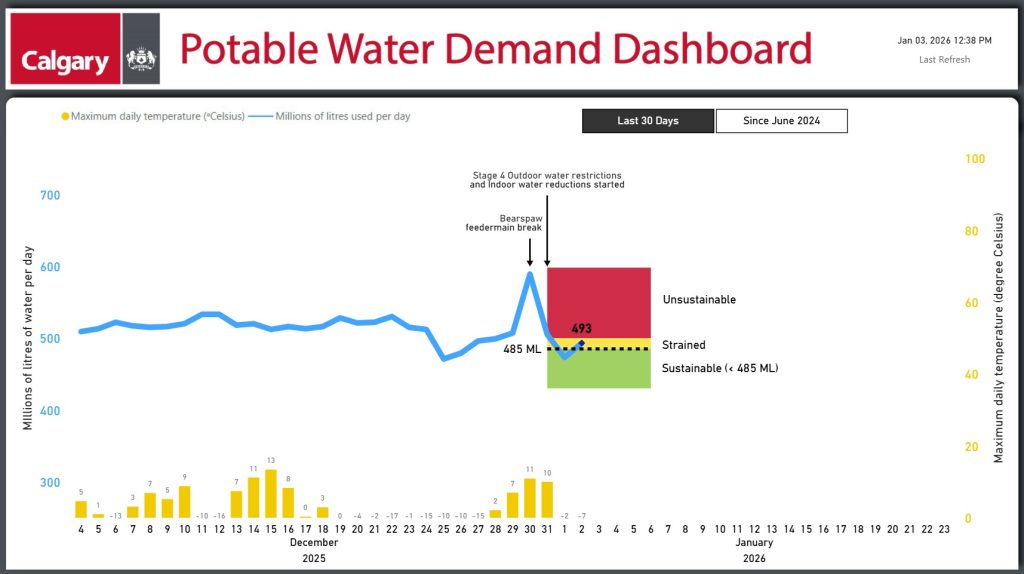
A boil advisory remains in place for Parkdale, Montgomery, Point McKay and West Hillhurst, and Stage 4 outdoor water restrictions remain in effect.
Calgarians and residents of Strathmore, Airdrie, Chestermere and Tsuut’ina Nation continue to be asked to do the following:
- Run dishwashers and laundry only when full.
- Limit showers to under three minutes.
- Flush toilets only when necessary.
Henry says a dishwasher cycle can use up to 20 litres of water, and a washing machine can use up to 112 litres of water, which is around 28 milk jugs per load.
“Please wait for a full load and help us to save water,” she said.
“An average fire truck holds 2,000 litres of water. If 67 people in Calgary saved 30 litres of water today, that’s enough for fire crews to arrive at an emergency and begin taking action.”
16 Avenue east reopens for Monday traffic
In a Sunday update, the city says a single eastbound lane on 16 Avenue NW will reopen east of Sarcee Trail prior to the morning commute on Monday. Additionally, access to eastbound 16 Avenue from Sarcee Trail will be reopened.
However, westbound traffic along 16 Avenue between 49 Street and Sarcee Trail remains closed. Speed is expected to be reduced as drivers travel through the construction area.
The update also mentioned there won’t be a left-hand turn from southbound 49 Street onto eastbound 16 Avenue since the latter street is returning to regular “operations.” Anyone wanting to head east on 16 Avenue should instead use Home Road.
“Please observe all construction signage in the area and expect delays,” the release reads. “Commuters are encouraged to use alternate routes, when possible, and expect delays while travelling through the area.”
This comes as Henry said Saturday that the city was planning on finding a way to alleviate the “anticipated congestion” as Calgarians head to work and back to school. She also said now is the time to be aware of your water consumption.
“We are worried about this demand on Monday and remind Calgarians to be really mindful of water consumption as you undertake a new routine in these circumstances,” she said.
This is the second time within a year and a half that a section of the Bearspaw South Feeder Main, which supplies 60 per cent of the treated water for the city of 1.6 million people, has burst.
The last rupture in the summer of 2024 prompted months of water restrictions, advisories and the invocation of a state of emergency.
Later in the emergency, residents who didn’t follow guidelines were slapped with fines.
More details on traffic detours and closures can be found on the City of Calgary website.
‘We will fix it and fix it for good’
Farkas, meanwhile, is saying city council is not only aiming for transparency as repairs are ongoing, but also responsibility and accountability.
“We’re doing everything that we can to not just address the short-term requirement for a fix to this feeder line, but make no mistake, Calgary is sitting on a ticking time bomb,” he said.
“This Bearspaw Feeder Main will continue to break until a complete alternative is built, so what we will do is absolutely what’s required to patch this pipe to get it back into service as soon as humanly possible.”
Farkas says a report and recommendation on the review conducted by a six-person panel following the break is slated for release on Jan. 13, adding the information will be made available to the public.
“We are absolutely committed to giving Calgarians the straight goods — the good, the bad and the ugly. If there are hard truths in that report, you will hear them,” he said.
“If there are gaps in governance, oversight or decision-making, we will acknowledge them, and if changes are needed, we will act on them as well.”
He is also claiming that no expense will be spared to fix the pipe, along with fixing the city’s water infrastructure overall.
“Our council is united, we will spare no expense to fix this, not just for today, not just for tomorrow, but for the next hundred years,” Farkas said. “We will fix this, and we will fix this for good.”
The cost to repair the 2024 break, according to the city, was around $40 million.
Farkas open to discuss provincial oversight of water systems
When asked if the province should take away municipal control of water services if it provides funding, Farkas said he is open to the conversation.
“We have been engaged deeply with the premier (Danielle Smith) as well as her designates … so we’re still at the point of assessing through this independent panel review what the governance and resourcing requirements might be in order to ensure that, on a big picture level, this doesn’t happen again here in Calgary,” he said.
This comes after Smith said Friday she would look into whether more oversight is needed for municipal water systems.
“When we put dollars now into municipal infrastructure, we have oversight,” she said, noting the province already oversees other utilities like electricity or gas.
She has said Calgary’s latest water woes stem from the city’s former mayor and current Opposition NDP Leader, Naheed Nenshi, neglect while in office.
Nenshi, who was mayor from 2010 to 2021 before becoming NDP leader, responded, saying inspections were always done and that there were no major water main breaks in the city in the 20 years before the 2024 failure.
He called Smith’s accusation “total garbage.”
Meanwhile, the city’s general manager of infrastructure, Michael Thompson, says the monitoring system used to alert them of risks to the pipe is under investigation.
He says the acoustic fibre optic monitoring system, installed following the June 2024 break in Bowness and Montgomery, is meant to provide continuous real-time monitoring of wire breaks and their exact locations along the feeder main.
“We know the monitoring system was operating normally at the time of the main; however, as demonstrated this week, monitoring alerts us to some risks, but it does not alert us to every failure,” Thompson said.
“We are continuing to investigate why the acoustic fibre optic monitoring didn’t pick up wire snaps for this break, and are determining what the failure mechanism was.”
He also says an investigation into the cause is still ongoing.
“As a result of the failure in December, we need to change our approach with respect to how we deal with this,” Thompson said.
“We know we need to adjust how we take action at this time. Our teams are exploring different options to support the stability of the pipe.”
More information on the water main break can be found online here.
With files from The Canadian Press