Alberta premier’s approach on judicial reform ‘not particularly helpful’: experts
Posted Feb 15, 2026 1:18 pm.
Last Updated Feb 16, 2026 11:55 am.
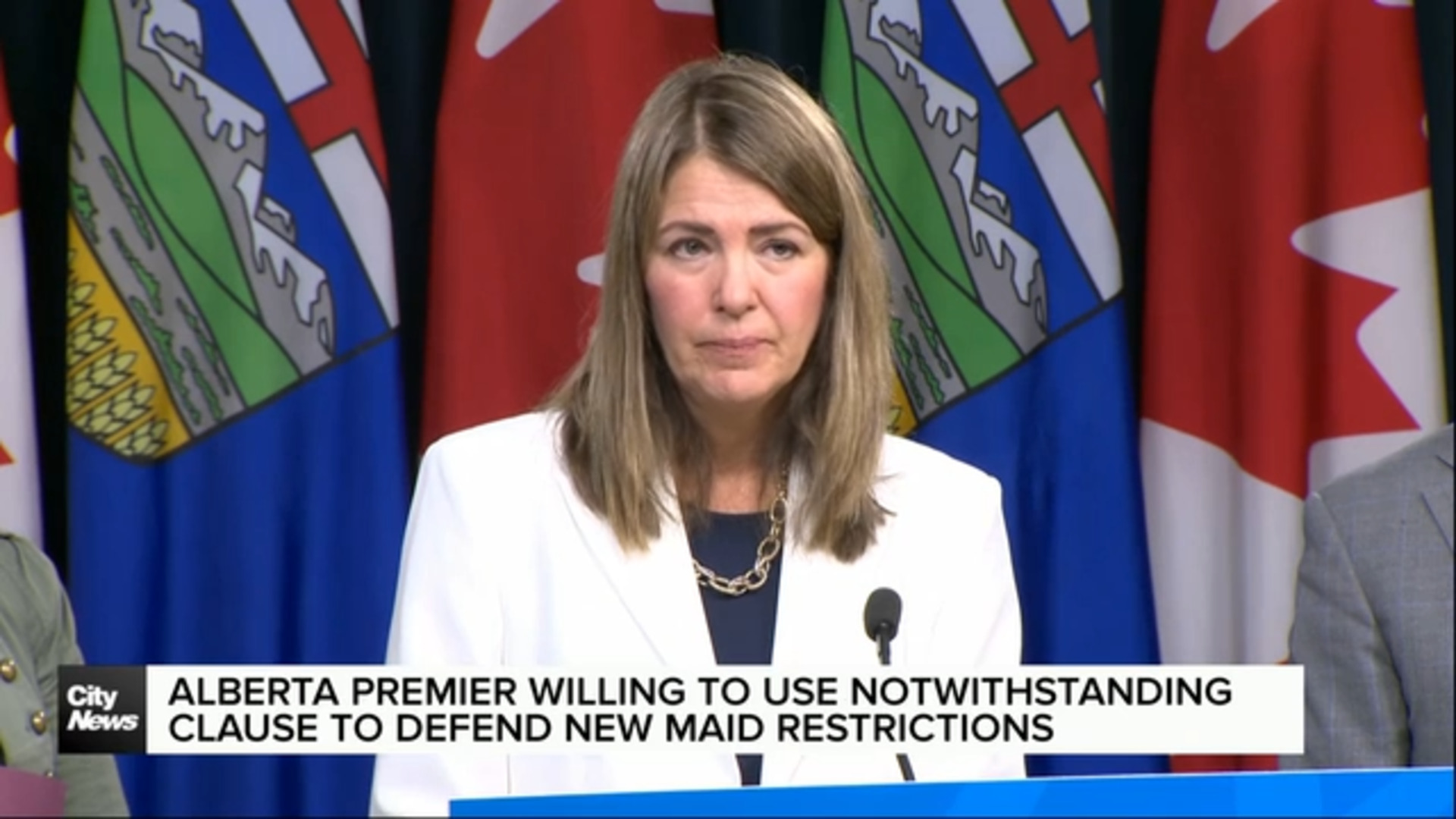
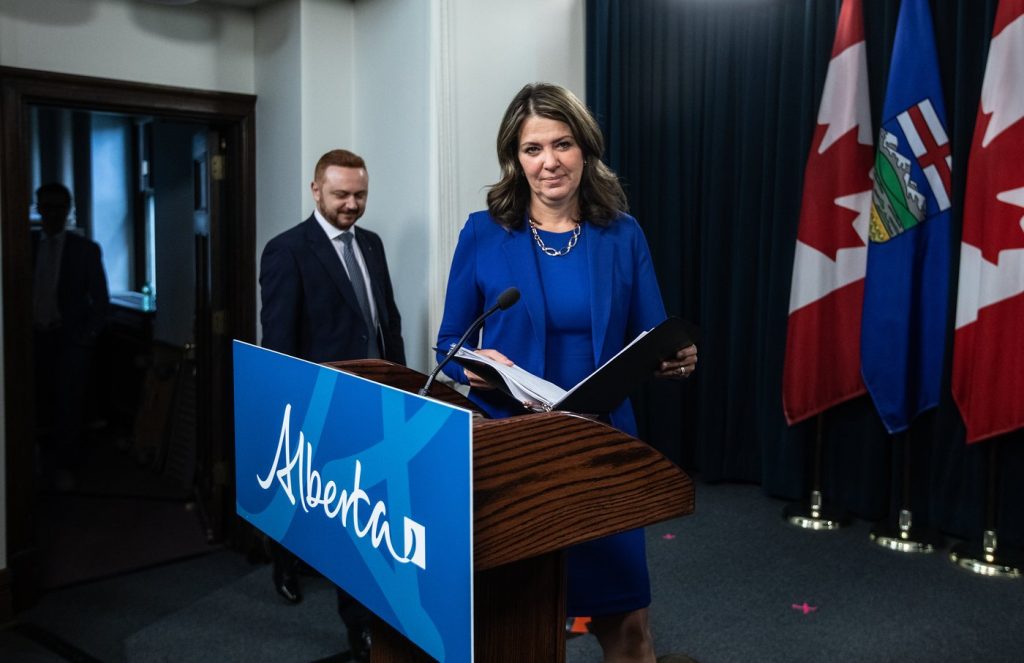
Experts and analysts alike say Alberta Premier Danielle Smith’s approach to seeking more say in judicial appointments is not helping her cause and that of other provinces.
Smith sent a letter to Prime Minister Mark Carney, which she made public in late January, threatening to withhold funding to the provincial judiciary if she didn’t have more input on appointing superior court judges and judges to the Supreme Court of Canada.
The letter sparked backlash from various institutions, including the Canadian Bar Association. The French lawyers’ association and the provincial chapter of the French Canadian Association also spoke out after Smith called for the removal of the bilingual requirement in judicial appointments.
The federal justice minister, Sean Fraser, defended the current system and said it wouldn’t be making changes.
She later said on the Corus Radio weekend show, Your Province, Your Premier, on Feb. 7, the request came from the Alberta Minister of Justice Mickey Amery.
Recently, when asked at an unrelated press conference on Thursday if it was a good idea to impact Albertans with less access to courts and justice as a result of her threat to cut judicial funding, Smith said it’s a matter of “reprioritizing resources.”
“We have an opportunity to appoint judges as well as masters that can do a lot of the work for the King’s Bench,” she said. “We just want the same kind of respect that Quebec has.
“We’ve been in talks with them (Quebec) about whether they would also like to see that same approach apply to the higher court levels, and I can tell you that there are a lot of premiers who think that that’s a good idea.”
Dr. Ian Holloway, a senior professor and former dean in the faculty of law at the University of Calgary, says the Alberta premier’s approach is “grandstanding” and only “engenders resentment” with all the provinces — including the western provinces.
“A more constructive way to approach this would be for her to engage with the other three Western premiers and, jointly, for the four of them to approach the federal government to ask for consultation before the next appointment is made,” he said.
“That, I think, is the constructive way to do it.”
Mount Royal University political scientist Lori Williams agrees, adding that Smith’s approach is “not particularly helpful.”
“There may be areas where advocacy or even making demands makes sense as part of a negotiating tactic, but when it comes to the judiciary that’s supposed to be independent, that’s an area where I don’t think it’s particularly helpful,” she said.
How does the appointment process work?
Smith’s letter calls for balance with the superior court process between representatives from the province and the federal government.
It proposes a special advisory committee with four “non-partisan experts” — two appointed by the province — to assess candidates on a “non-partisan basis” while ensuring candidates have the expertise to serve in roles on the Alberta Court of King’s Bench, the Alberta Court of Appeal, and the Supreme Court of Canada.
She also said it would ensure judicial appointments “appropriately reflect Alberta’s distinct legal traditions,” and strengthen public confidence in the administration of justice.
Provincial superior courts are appointed by a seven-person committee, Holloway says, with three appointees representing the public from the federal government, and another from the province’s chief justice. The remaining choices come from specific provincial institutions, including one from the Ministry of Justice.
Stemming from Confederation in 1867 and the result of the U.S. Civil War, Holloway, who delved into the history and the judicial appointment process, says it was agreed provincial governments wouldn’t make judicial appointments because those judges are representatives of Canada.
This means they could take a case for someone not from Alberta, representing Canadian law in the courts.
“That was a very deliberate policy choice made by the representatives of the various provinces, so that’s a pretty fundamental principle of our constitutional structure, that the feds appoint the superior court judges of each province,” he said.
He also says the claim for a better reflection of Alberta values and legal traditions is possibly spurious, as all judges appointed in the province are Albertan.
“Every judge we have in this province has spent at least 10 years as an Alberta lawyer. So … it’s not as if Ottawa’s parachuting judges in from other provinces. That’s not the way it works,” Holloway said.
“Presumably, all of our judges already have Alberta values, because they’ve been practicing as Alberta lawyers for at least a decade. So I don’t know what she means by Alberta values, if she thinks that the current system doesn’t lead to judges having Alberta values.”
Smith’s press secretary — along with the minister of justice’s office — didn’t answer CityNews’ questions.
The Office of the Commissioner for Federal Judicial Affairs Canada (FJA) was created in 1978 to oversee the superior court appointment process and “safeguard the independence of the judiciary.” It was adjusted in 1988 and has seen several changes since then, including in 2016, which saw the commission share stats on judicial appointments for transparency.
As of Feb. 1, 2026, 702 judges have been appointed since 2016.
Alberta asking for a constitutional amendment
Smith’s letter to Carney was sent without holding a referendum on constitutional reform, which the Alberta Next Panel — the one she chairs — recommended in its report.
“While we believe it is time for a broader discussion around Constitutional reform, for practical purposes we agree that focusing on piecemeal amendments to enhance provincial powers is the best way to get all or most provinces on board and achieve meaningful change in the shorter term,” the report reads.
“Constitutionally entrenching provincial autonomy in matters of provincial jurisdiction is more important than ever. It will also help achieve the vision of those who founded our nation.”
The Alberta Next Panel was a 16-person panel led by the premier, who travelled around the province to host town halls in 2025. Smith framed the initiative as an opportunity to reassess Alberta’s relationship with Ottawa.
In-person and online surveys were conducted on several issues, including asking if a referendum should be held on constitutional reform. Recommendations were made calling for autonomy, with many calling for referendums.
Holloway says the premier is asking for a “radical shakeup” in the appointment process.
“In fact, I’m not sure if she’s aware of it, but she’s asking for basically a constitutional amendment,” he said, clarifying that the process already has lots of input from Alberta lawyers and Albertans overall.
“What there isn’t is a lot of UCP input — at least not direct UCP input,” he said. “And that, I think, is what the premier wants.”
Williams echoes Holloway.
“It may be informal in terms of some of the input that is used or consulted there, but it sounds like Danielle Smith wants to completely replace the committee with something that will simply have members of the government at the federal and provincial level, and that would remove that independent portion of it,” she said.
She adds judges’ independence also stems from the need to limit the “excessive use of government power.”
“They’re meant to be independent. They’re meant not to be responsive to the majority because majorities, sadly, sometimes can be tyrannical,” she said.
The Alberta Next panel said there was majority support in the survey and in-person townhalls for a referendum, but sent the letter without having one.
Questions to Smith’s press secretary went unanswered, as did questions to the minister of justice.
Meanwhile, Williams also says Smith’s rhetoric is nothing new, referencing her comments on the notwithstanding clause on judges and wanting to direct judges’ decisions in courtrooms.
“The big concern with all of this is that Danielle Smith keeps suggesting that somehow or another, the decisions made by courts and by judges are illegitimate,” she said.
“And this goes all the way back to her musings about directing prosecutors as to how they should manage the Coutts border blockade prosecutions.”
Emulating U.S. judicial appointment process would make it political
The demands in the letter reference the U.S. and Australia as leading examples of countries where states appoint judges and have a say on their respective supreme courts. It’s also mentioned in the Alberta Next Panel recommendation report.
“In federal political systems like the US and Australia, the power to appoint the state superior court judges (the equivalent of Alberta’s King Bench [sic] and Court of Appeal judges) resides with the state government and not the federal government. In this respect, Canada is an outlier, and the panel is of the view that the power of appointment should be with the provinces,” the report reads.
Holloway says emulating the U.S. appointment process is the “worst thing to do.”
“The American judicial appointment process is so heavily politicized,” he said.
“It’s quite simple: a Republican government appoints Republican judges and a Democratic government appoints Democratic judges. And that is the last thing that we want to do.”
He says the one thing that the American experience does is illustrate why the stakes are so high in Canada, mentioning U.S. President Donald Trump’s appointment of three of the nine judges on the U.S. Supreme Court.
“That means that long after he’s out of office, his legacy will live on … so for us, I think we need to be aware of the American experience so as to avoid it,” Holloway said.
When it comes to Australia, he says the states do choose their judges. However, Holloway adds it’s naive to emulate Australia as it requires major constitutional reform, as the system is widely different from Canada’s.
“I think that in order to emulate Australia, the Constitution would need to be changed, and with respect to Superior Court appointments and that, given the realities of Canada today, that’s just not going to happen,” he explained.
“It’s just that the idea of a major constitutional change taking place in this country is just not on the cards.”
CityNews asked Smith’s press secretary and the minister of justice’s office about the research supporting the report’s findings, which went unanswered.
Reform appointment process not unwarranted; more input from provinces needed
Previously, a report by Postmedia and the Investigative Journalism Bureau found a large number of superior court judges donated to the Liberal Party under former Prime Minister Justin Trudeau before they were appointed. The latter also found Alberta judges donated to the UCP after they were appointed, which runs against ethical standards for judges.
Holloway said it’s not unfounded to want reform with the judicial appointment process, but says there should be a more constructive approach that includes the other provinces.
Additionally, the Supreme Court appointment process also holds three spots for Quebec, which has a committee for those appointments made in 2016. Holloway says this is because Quebec uses a completely different legal system called the civil law, inherited from France. The rest of the country uses the common law inherited from England.
“Because the Supreme Court hears these big, complex constitutional cases, there needs to be a critical mass of people who come from the civil law, the French law tradition,” he said.
“That’s controversial in some people’s minds. ‘It’s yet another example of the balance being distorted to suit one province,’ but it is the way it is.”
The remaining judges are also chosen by tradition or by custom, not by law. It says one comes from Atlantic Canada, three from Ontario, and two from western Canada.
“In terms of the Western seats, we’ve had a lock hold for a long time. Now, the premier would say that makes sense, ‘We’re the economic powerhouse of the West.’ B.C. might have a different view on that,” he said.
Holloway says in the case of the Atlantic and western seats, arguments among the provinces can erupt. In the case of Prince Edward Island and Newfoundland, the former hasn’t had a representative since the late 1800s or early 1900s, and the latter didn’t have one before Justice Malcolm Rowe.
However, he says legal professionals in Manitoba, Saskatchewan, and B.C. will go “ballistic” if another Alberta judge is appointed, since two of the judges are from Alberta, with one of them being appointed after another Alberta judge retired.
“There’s this feeling in Manitoba, Saskatchewan, B.C., that Alberta has had way too much say in the Supreme Court in recent years,” he said.
Meanwhile, Williams says every premier is essentially going to do what’s good for their province, along with noting genuine concerns and actions calling for change. The Meech Lake Accord, for example, was a series of proposed constitutional amendments that sought to see Quebec endorse the 1982 constitution. It was discussed and agreed upon by all the provinces, but it ultimately failed.
“There have been rather informal changes in providing more input. It may be that provinces generally want to have more input,” she said.
“But I think we as citizens want to make sure that there’s more in the way of independent voices influencing what happens in those judicial appointments than governmental voices, just to keep that arm’s length from the government in place.”
Regardless, Holloway says a constitutional amendment is needed if any changes are to happen in the courts, a system “grounded in history.”
“In our case, it’s that very particular history of the U.S. Civil War being fought over states’ rights, and our fathers of the Confederation making a very conscious, very deliberate policy choice, which is reflected in our Constitution, in Section 96 of our Constitution,” he said.
“And so for any province — for the Premier to get anything other than an agreement to consult, it would require a constitutional amendment, and I just think it’s unrealistic to think that in Canada today, given how divided we are, that a constitutional amendment like this is on the cards.”