Calgary feedermain break result of relaxed pipe manufacturing standards, engineers, geoscientists say
Posted May 28, 2025 11:29 am.
Last Updated May 28, 2025 6:22 pm.
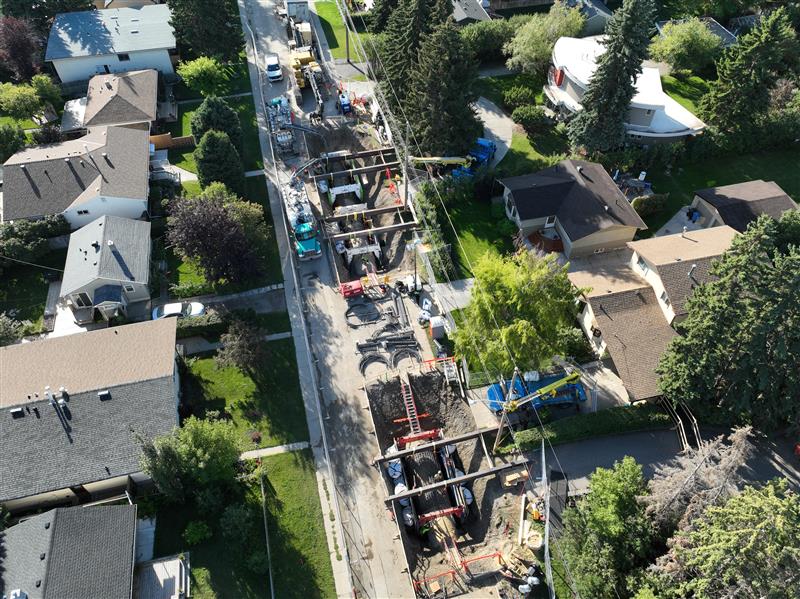
The Association of Professional Engineers and Geoscientists of Alberta (APEGA) is out with its report on the Bearspaw South Feedermain break that threw Calgary into tight water restrictions for the majority of the summer of 2024.
APEGA says the review started on July 22, 2024, more than one month after the rupture began. It was presented to the City of Calgary earlier this month.
The review found the city had “sound engineering oversight” and the “appropriate risk-based management” in place to meet all relevant standards.
There was no indication of unskilled work or unprofessional conduct found during the review, according to APEGA. If there were, the organization would’ve launched a formal investigation.
APEGA’s review included a high-level literature review which gave context to the magnitude of mechanisms of prestressed concrete cylinder pipe (PCCP) failures, the organization says.
When the feedermain was installed in 1974, it was expected to have a service life of 100 years.
However, APEGA explains PCCP-manufacturing standards were relaxed from the late 1960s to the early 1970s by the American Water Works Association, which resulted in a high rate of premature failures.
Standards have since been strengthened, according to APEGA.
Conclusions drawn by the City of Calgary’s own forensic investigation are consistent with PCCP failures across North America, the association says.
“PCCPs generally fail in the same way, and such failures are common,” it adds.
Furthermore, preventing a PCCP rupture isn’t assured, even if monitoring and predictive technologies are in place.
Mayor Jyoti Gondek says she is pleased the report confirmed the incident was not a fault of the city’s engineers.
“This outcome is a credit to the dedicated City staff and engineers who worked tirelessly to respond to a critical infrastructure failure. Their professionalism ensured that Calgarians continued to have access to safe water under extremely challenging circumstances,” she said in a statement. “APEGA’s report also highlights what we’ve come to understand about prestressed concrete cylinder pipe (PCCP) — unfortunately, failures like this have become common across North America.”
Gondek says she and GM Michael Thompson are working together to give a comprehensive update next week where they will share a full account of the city’s response, the improvements underway, and the forward-looking infrastructure strategy.