Government decides to keep the royalty structure and rates, but change up framework
Posted Jan 29, 2016 3:48 pm.
This article is more than 5 years old.
It’s become one of the most highly politicized topics as of late in the province, and it’s certainly been the talk of Alberta’s energy industry; the royalty review.
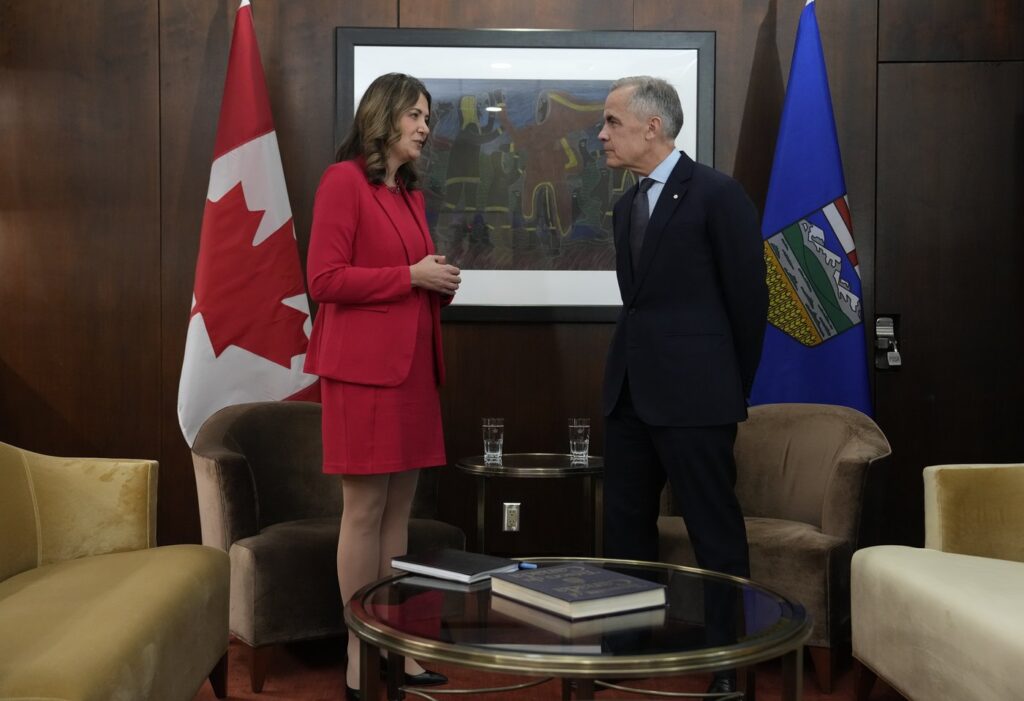
On Friday morning, Premier Rachel Notley, along with the panel’s chair Dave Mowat and Energy Minister Marg McCuaig-Boyd announced sweeping changes to the way royalties are collected in the province.
Media was given a first-hand look at how the new policies surrounding the energy sector will work, with industry stakeholders getting their update at the same time, in an adjacent room.
The panel found Alberta’s royalties are comparable with other jurisdictions, but it also cited a need for changes to the structure.
The panel focused on four recommendations to the government, with establishing principles and design criteria at the top of the list.
They felt Albertans didn’t understand what the framework is intended to do and it was their hope “guiding principles” would share more insight as to how the process works.
They’re looking for modernization to a royalty framework that hasn’t changed since the days of Premier Stelmach.
“The modernized framework is to be calibrated such that the returns for industry and the share of value captured by Albertans match the returns generated under the current regime, taking into account that at very high and very low prices the current incentive programs do not achieve their intended goals of accurately reflecting costs or stimulating development,” the report read.
In some cases, depending on the level of investment, it can take a company 12 years to pay out their royalties to the government coffers.
The only new money coming into the government will be projects that now have to undertake the “pre-payout” phase as opposed to paying afterwards, as was previously done.
All the changes being made will apply to new wells only moving forward.
Existing royalties will remain in place for 10 years on investments already made.
The panel is also calling on the harmonization of royalty structures across crude oil, liquids and natural gas, that emulates a “revenue minus cost approach.”
They’re eliminating the expiring drilling programs and replacing them with a permanent formula to easily calculate drilling and completion cost allowances.
They will apply a flat 5 per cent royalty rate until revenues from a well equal the well’s drilling and completion cost allowance, followed by higher post-payout royalty rates that increase with price.
The hope is that this will encourage industry to be more innovative, allowing them to pay into a lower royalty rate so they can complete the well.
Their third recommendation calls for the government to retain the current structure and royalty rates for oil sands – what they’re changing is the process.
They want more transparency in allowable costs from industry because they found most Albertans have lost confidence in what is coming out of the energy sector.
Panel members are finally asking the government to develop a natural gas strategy for Alberta, examining opportunities to accelerate the development and commercialization of partial upgrading and alternative value-creation technologies for bitumen.
They freely admit they heard the argument that government should “do nothing” or “leave the current framework alone”, but instead chose to move forward.
“We understand the nature of these comments. The truth is that the current framework is not only behind the times but also includes temporary programs that are due to expire. Taking no action would result in a flight of investment away from Alberta, a decline in oil and gas production, and lower royalties to Albertans over time, to say nothing of the negative employment and economic impact that would also result.”
Royalty rates are low, typically 5 per cent. The panel wanted to put in place something that addresses the fundamental differences with particular companies.
The government has adopted the new policy framework and officials say they won’t take effect until 2017.
“We cannot continue to operate with a perspective that the world needs to come to Alberta if it wants oil and gas,” the report added. “Advances in technology have unlocked significant new sources of oil and gas supplies, particularly from unconventional deposits in the United States. The U.S. is now a rejuvenated force in oil and gas production, one that poses huge risks to Alberta’s market share.”
They argue this is problematic since we have relied on the Americans as a customer in the past.
It also cited an argument heard before by the NDP government, environmental expectations are increasingly influencing our ability to access new markets and our social license to develop our energy resources.
Government officials feel we need an ongoing reason to look at new opportunities, with the phase-out of coal in the coming decades.
At the current prices, they say payout does appear to happen at a slower rate but with the newer framework, they feel there will be an additional 5,000 barrels by 2023 subject to royalty payouts.
In short, the value of royalties will be determined by the prices received for our resources, minus the costs to produce and sell them.
The rates charged each month on each well and project can change depending on resource prices, production levels and even the depth of wells.
Officials expect the total revenue collected in the first year will be exactly the same.
They hope the new “scheme” will drive down industry costs and make the energy sector more competitive with markets south of the border.
A carbon levy will be built into the industry cost and they’re not expecting much to change.
“New large-scale projects in Alberta’s oil sands are not expected for the foreseeable future. There are many reasons for this. First, there have been structural change since the oil industry.”