More to fear than the horseman: ATP’s ‘Sleepy Hollow’ a surprising kind of post-COVID scary
Posted Oct 31, 2025 10:30 am.
If you want to see The Legend of Sleepy Hollow at Alberta Theatre Projects, let’s hope you already have your ticket. Before opening night, the show was 90 per cent sold out. As of print, despite an added performance, it’s over 95% sold out, with only single tickets remaining.
You could always sit separately from your date — or go alone.
But then how will you unpack the rich complex existential horror of the text?
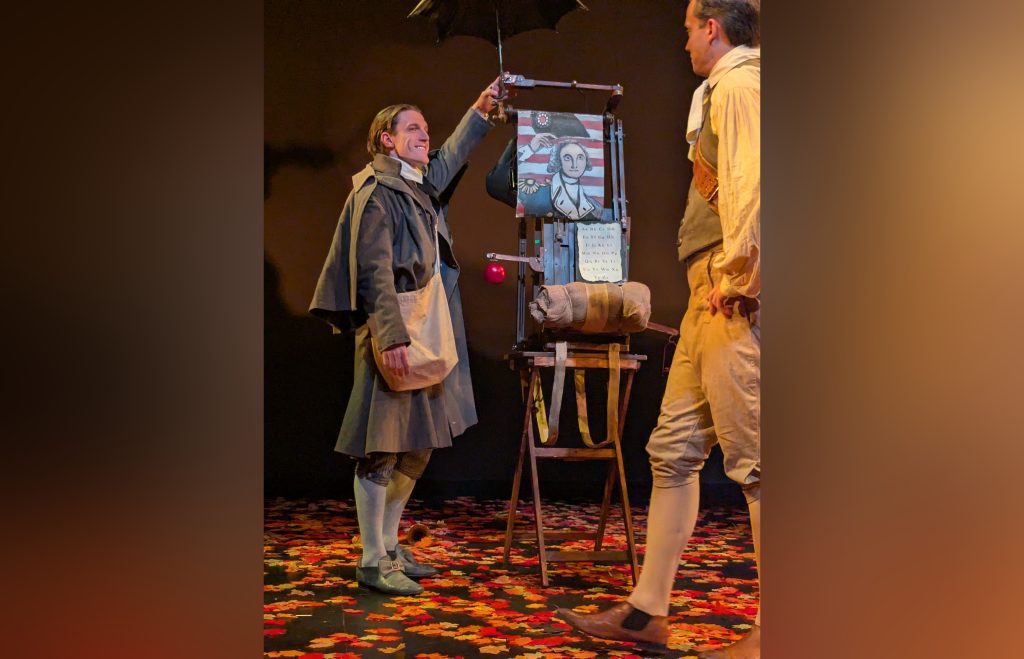
First, the backstory: This production is the culmination of years of work for some, the accomplishment of dreams for others, and a big checkmark on the bucket list for the man playing Ichabod. It’s a combination of talents from the Banff Centre for Arts and Creativity, The Old Trout Puppet Workshop, and Alberta Theatre Projects.
Co-writer and Old Trout co-artistic director Peter Balkwill says the show has been years in the making “a relationship that began with ATP and the Banff Centre, pre-COVID.” Before the world shut down, the pitch was made to rework Washington Irving’s short story about the Headless Horseman and to do it in a way that the titular character could be reimagined through an Old Trout creation.
The pandemic pause allowed the team time to research extensively. The playwriting cohort worked on the script for over six years. What’s now selling out in Calgary was six years in the making, with its initial premiere in Banff.
“Every project offers the opportunity to learn something that you didn’t know before,” Balkwill says with a smile. “One of the things that the Old Trouts like to do is never replicate a process previously engaged. That could be because we’re too simple to remember what we did previously, but it’s a way for us to continue to push through the envelope of originality and to reinvent and rediscover our process anew each time.”
Beyond just the Horseman, the Trouts designed the set, costumes, other puppets, and props. The production also features the lighting artistry of Sonoyo Nishikawa, whose collaboration adds eerie dimension to the play’s fog-filled world.
Her contribution came about by chance — an artistic coincidence that speaks to the collaborative nature of theatre. Balkwill says the Trouts met her when they were shortlisted for the Siminovitch Prize in Theatre. She won the award and later found herself working at Banff.
“So we called her up because we were friends now, and we said, hey, do you want to pop your lights onto our set design and our costume design and muck about with how we’re going to present this script and play with any puppets that are in it?”
Premiering the show in Banff brought a special kind of magic — from inception to development to performance. For Matthew Mooney, originally from Scotland and now playing Ichabod, the Banff experience fulfilled a dream years in the making.
“Banff is the reason I came here in the first place,” he says. “It was the Banff Film Festival that I saw back in Edinburgh during COVID.”
He fell in love with Banff from abroad and made a life-changing decision that night.
“I applied for a visa at three o’clock in the morning that night and then got it and tried my best to move there — and five years later, I’ve achieved that.”
For all parties involved, The Legend of Sleepy Hollow has become the culmination of goals set half a decade ago.
The time it took to write the script also lent the team the opportunity to explore beyond Irving’s original story. The play digs deep into conversations about education, democracy, rights, freedoms, and the tension between Canadians (the Loyalists) and Americans (the Revolutionaries). It also reminds audiences of the wounds left by war.
It’s easy to forget the collective trauma people must have felt post–Revolutionary War and the signing of the Declaration of Independence — in a world with no phones, no power, and public education just on the horizon. All of these layers make the Headless Horseman the least scary thing on stage; instead, the show confronts an existential kind of terror that is much too prescient in modern day.
Mooney says that fact is evident in the audience reactions to otherwise innocuous points.
“The way Anna [Cummer] and Judd [Palmer] have written this script is incredible because it’s reflective of the current climate,” he said. “What’s happening in America is also happening in Europe — the rise of questionable politicians, the impact of war, the way we define loyalty. It’s all still relevant.”