‘A Doll’s House’ at Theatre Calgary keeps the same questions about gendered roles alive
Posted Apr 21, 2026 7:15 am.
Ask the same questions about a play for 147 years and see how the answers shift. And that remains the case as A Doll’s House by Henrik Ibsen is now onstage at Theatre Calgary until May 3.
The script first premiered in 1879, and calls into question traditional gender roles in 19th-century Norway.
In particular, it critiques the economic dependence of women and how it can obscure reality as people perform expected roles rather than live their truths.
Elements of the show have proven so controversial that at various points throughout history, the script, including the ending, has been rewritten prior to performance.
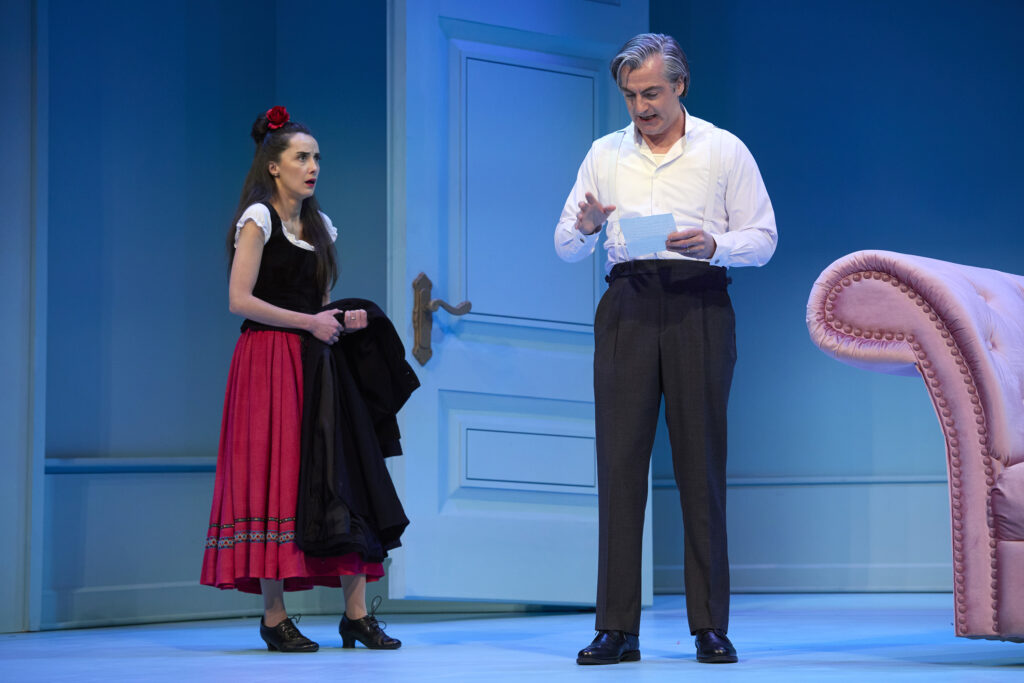
Nora is the female lead, a complicated and nuanced woman who appears both naïve and deeply strategic. Alexandra Lainfiesta plays Nora in the Theatre Calgary production.
“I think it’s a gift for any actor who is in love with the craft of acting,” Lainfiesta says. “Nora is such a complex individual.”
But she is carrying a secret that could have real consequences for her family’s reputation and her marriage.
Lainfiesta says the smaller lies and manipulations that often read as malicious are better understood as survival tactics.
“It’s a learned behaviour,” she says. “As we find out throughout the play, she practiced this with her father. Now she’s in a new house and doing the same thing.”
Nora is not the only problematic character onstage. Every role is written as deeply human, and therefore deeply fallible.
Lainfiesta says teenage audiences, in particular, are quick to spot that complexity.
“What’s beautiful and interesting is the matinees with the teens,” she says. “They’re so advanced in understanding toxic dynamics. They get it right away. They see the red flags immediately.”
Warning: Spoilers to ‘A Doll’s House’ to follow
The most controversial element of A Doll’s House has always been its ending, when Nora decides to leave her marriage and children in search of her true self.
She likens her life to that of a doll in a house, and realizes she has, in turn, turned her children into dolls as well.
The question of what it means that she leaves, whether she is justified, and what it means for the family she leaves behind has fueled debate for generations.
The ending has been rewritten multiple times throughout history as a result.
Lainfiesta says teens today are generally pro-Nora.
“One of the teens asked, ‘Do you think Nora has to pay child support?'” she says. “And that just opened everything up.”
“In today’s world, she probably would,” Lainfiesta says. “But in 1879, once a woman removed herself from the role of wife and mother, it was as if she disappeared. She no longer participated in that world.”
The question of whether Nora is right to leave at the end, or should have stayed for the sake of her responsibilities to her children and marriage, continues to spark debate nearly 150 years on.
Teens, it seems, are largely supportive of her ultimate choice, which ends with a slammed door.
A Doll’s House plays at Theatre Calgary through May 3.
Tickets are available on the Theatre Calgary website.